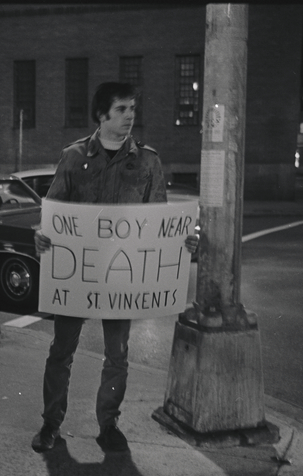
Remembering GLF Member Marty Robinson
The tactician who helped the Stonewall Uprising last six nights — and went on to create the “zaps.”
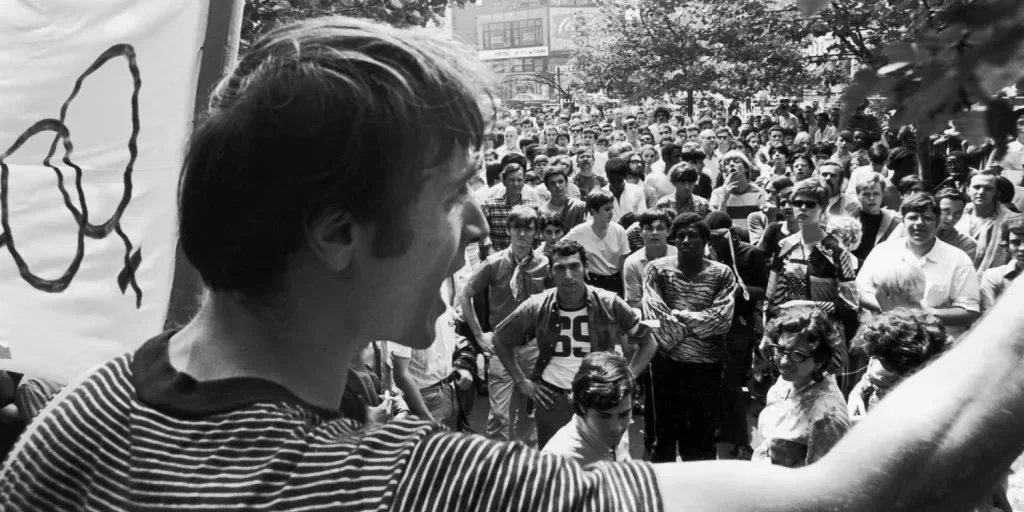
Marty Robinson speaks at first march after Stonewall, July 1969
Marty Robinson was one of the most influential activists to emerge from the period immediately following the Stonewall uprising. Present on Christopher Street during the uprising, he helped transform a spontaneous rebellion into an organized movement and later became a leading figure in both the Gay Liberation Front (GLF) and the Gay Activists Alliance (GAA).
According to fellow activist Mark Segal, Robinson recognized the importance of sustaining the momentum of the uprising and encouraged activists to spread the word throughout Greenwich Village, helping bring people back to Christopher Street on subsequent nights.
Mark remembers that “on my first or second week in New York, I tried to go into Mattachine. They said I was too young. As I was leaving, that's where I met Marty Robinson, who was coming out, and he said, "You know, these guys, they don't get it. They don't understand what's going on in 1969. We just can't be doing a once-a-year march. We need to do something more."
He created the action group which I was a member of. There were many little groups around New York. After Stonewall, we all united for the first time. Action groups, fairies, lesbians, we got together. That's what created Gay Liberation Front. It was the first united movement in our country from the grassroots up. Before that, drag queens weren't allowed to be part of it. Street kids like me weren't allowed to be part of any movement.
Marty Robinson, who was the leader of the action group which I was part of, came up to me with chalk. I'm one of those people who wrote up and down the streets, "Tomorrow night, Stonewall," which created, in a sense, the second night where activists spoke from the front door of the Stonewall and made the point clear that we were oppressed. We needed to do something. And that meant fight back.”
In the weeks that followed, he was among the activists who broke with the more cautious Mattachine Society and helped found the Gay Liberation Front.
Robinson helped organize the earliest public demonstrations after Stonewall. He spoke at the July 1969 rally in Sheridan Square following a march from Christopher Street, one of the first organized political actions to emerge from the uprising. These demonstrations helped establish a new model of gay activism based on visibility, public protest, and direct action.
By the end of 1969, Robinson joined other activists in leaving GLF to help found the Gay Activists Alliance. Within GAA he became one of the movement's most creative tacticians. He is credited with the development of the "zap," a form of highly visible, nonviolent direct action designed to confront politicians, public officials, and institutions that ignored or discriminated against gay people. The tactic became one of the defining strategies of early gay rights activism and influenced later generations of LGBTQ organizers.
During the AIDS crisis, Robinson remained active in advocacy and organizing until his death from AIDS-related illness in 1992. He was also a founding member of ACT UP and the Treatment and Data group in ACT UP
His approach to activism—strategic, confrontational, media-conscious, and unapologetically public—helped shape the course of gay liberation and the movements that followed.